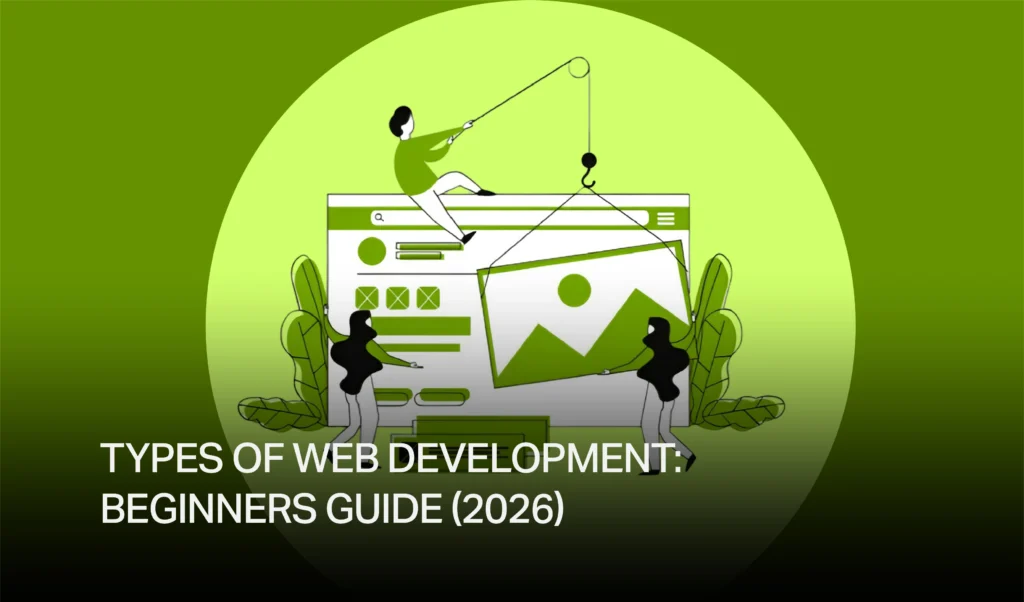
Every website you visit is a small world made with different types of web development. Where each helping what you see, feel, and interact with. The colors that attract your eyes, the buttons that respond instantly, and the features that work quietly in the background.
All these come from front-end website development, back-end website development, and full-stack website development. Together, they and web development strategies change code into responsive, visually appealing, and interactive experiences through design, server communication, and essential website functions.
Brands depend on advanced web development in the digital market. Because online visibility begins with a strong structure. And to help you get a good command of it, Innova Designz has made this web development for beginners into a clear and simple journey through the main types.
How Many Types of Web-Based Development Are There?
There are initially three main types of advanced website development, which include front-end, back-end, and full-stack. Each type uses various technologies to create a user interface. Developers handle different parts of designing, server-side logic, databases, and website functions.
Points to Focus On:
- Three core categories exist in most modern web projects.
- Each type supports a different user experience and server-side needs.
- Together, they form a complete approach for web-based development.
These three types work together to make a responsive and interactive website. They also help developers maintain strong performance and smooth server communication.
Describing the Main Types of Web Development
There are 3 basic types of web-based development that are used to create a modern website. Each type will require certain skills, technologies, and other components.
Below is a basic breakdown of the three main types of modern website development and what types of things are included in each type.
Front End Web Development
Front-end web development involves the sections a web user will see and engage with. This type of web development brings visuals together. That includes colours and graphical displays to convert designs into interactive user interfaces.
The user must be able to interact with the website regardless of the screen size he/she is using. The combination of creative and technical skills in front-end web development provides a positive user experience.
Elements Used in Front-End Development
HTML (HyperText Markup Language)
HTML made the essential foundation for all web pages, which includes structure, organization, and hierarchy of the content in a format. That is easy to read and used by browsers to display on web pages properly across all web browsers.
It also helps developers to organize text, images, links, layout elements, and to display pages of a website.
CSS (Cascading Style Sheets)
Web pages are completely controlled by CSS. CSS controls how the entire web page looks. This includes color, font style, space between elements, animation, and the responsive layout of the page’s content.
With the use of CSS, every web page is visually appealing and functional from either a desktop computer, tablet, or mobile device.
JavaScript
JavaScript provides websites with interactivity, user-driven interactions, and real-time updates. That ultimately provides a more responsive and lively website experience.
It also gives the capability to create menus, buttons, forms, animations, and many other interactive features.
Back End Web Development
Back-end website development involves managing all of the processes. That takes place ‘behind the scenes’ of a website to make sure that the site operates securely without any errors. This type of development concentrates on everything that takes place on the server side.
This includes: database/functionality communication; application architecture; server-side logic; etc. While the user cannot physically see the back-end, it provides essential functions for a website (e.g., support for login authentication, support for data storage, content delivery, transaction processing, etc.)
Elements Used in Back-End Development
Programming Languages
Server-side best programming languages for web development are used to implement logic by processing. That includes user requests, validating input, and performing the essential functions of the website.
These languages are responsible for keeping transactions secure, maintaining high-performance levels, and providing an interface between the user’s web browser and the back-end of the server.
Databases
Databases keep all the information that your website requires. These involve user account information, product descriptions, blog posts, and etc.
That can be used to quickly recover both structured and unstructured information. This also allows a website to give users accurate information on time.
APIs
With Application Programming Interfaces, there is no need for complex programming to enable the exchange of data between different systems.
Instead, APIs enable the facilitation of payments through a variety of payment processing vendors, user authentication using a single set of credentials, and customer insight collection to determine customer preferences.
Full Stack Web Development
For making a complete web application, developers use the term full-stack web development. That is the combination of front-end and back-end web development. The work of a full-stack web developer involves making the user interface (the part that users will interact with), handling all of the data for a web application, controlling the logic on the server, and maintaining data.
It also provides developers with a broad knowledge of many different types of technology, tools, and the most popular web development frameworks. It also provides an extremely flexible, efficient, and streamlined method to develop an application.
Elements Used in Full Stack Development
Front-End toolkits
Both front-end and back-end toolkits provide developers with flexibility for making user interfaces. These toolkits contain modularized pieces that result in faster performance.
By using a combination of front-end and back-end toolkits, developers are able to produce better, faster, and more user-friendly interfaces for all platforms and devices.
Back-End toolkits
The use of back-end toolkits gives developers the tools necessary to create secure, scalable, and logical web-based applications.
These back-end toolkits provide the ability to create complicated applications quickly.
Version Control Systems
Version control software allows developers to track all code changes and offer a historical record for the development team to refer back to throughout the life of the project.
Its tools also help developers to collaborate on projects by coordinating developers and helping prevent conflicts.
FAQ’s
What is website development?
Website development involves structuring, designing, and maintaining websites through front-end and back-end processes.
Which programming language adds interactivity to websites?
JavaScript adds interactivity and supports dynamic behavior on web browsers.
What are the types of web development?
The main types include front-end, back-end, full-stack, mobile, e-commerce, CMS, and enterprise development.
What are the types of website structure?
Common structures include hierarchical, successional, database, and network layouts.
What are the phases of web development?
Phases include discovery, planning, designing, development, testing, launch, and conservation.
Build Better Websites with Innova Designz
Explore the best types of website development services available from Innova Designz. We create responsive and engaging websites that support your business growth. Our web development team practices utilizing modern technologies to create clean user interfaces and logical communication between your server and your users.
Let our experienced team turn your vision into reality with high-quality digital experiences!