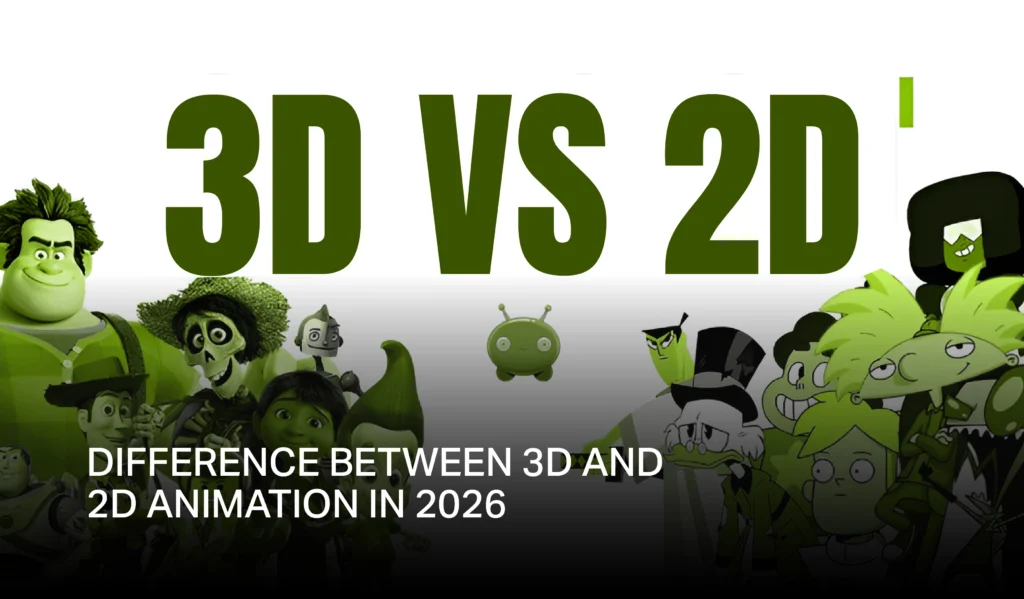
Animation has become one of the exciting stories in this new and advanced digital chapter. It’s changing the way brands connect to their audience with websites, marketing juggernauts, and gaming. The mix of artistic creativity and technology welcomed companies across the world in 2026.
But one question stays at its place: “The difference between 3D and 2D Animation.” Which needs expensive software, which one has a long production cycle, and tools are needed for each to counter every question this year’s Innova Design has created this guide. So let’s walk with us to get your answers cleared about 2d vs 3d animation!
Why Understanding 2D and 3D Animation Matters
Multimedia is now all about animation. Animators use animation that is based on either 2D (two-dimensional) or 3D(three-dimensional). But when you’re creating games, apps, and marketing products, having a good grip on 2d vs 3d animation will help animators determine which approach will give the stylish results.
Key hooks:
- 2D animation uses vector graphics for its animation and has a very flat appearance.
- 3D animation uses 3D models to create realistic depth and motion.
Combining Types of 2d Animation Styles, 2D 3D animations will create a more visually rich experience. By understanding the 2d or 3d animation, you can create an animated project. That will meet your audience’s expectations and deliver exciting results.
What is 2D Animation?
2D animation is the process of creating an illusion of movement. In this type of animation, the 2D drawings or images are displayed in a series of rapid succession. These 2D drawings or images are typically created using the X-axis (horizontal direction) and Y-axis (vertical direction). By combining the 2d animation vector methods of creating artwork, the animator tells a story. That can effectively create interesting narratives.
Types of 2d Animation Styles:
- Traditional Animation: Hand-drawn frames produce a constant inflow of movement.
- Vector-Based Animation: Graphics that are digitally scalable and induce smooth transitions between frames.
- Motion Graphics: Animated textbooks and shapes used for promotional advertising or branding.
- Cut-Out Animation: Digitally manipulated, layered particulars.
- Stop Motion Animation: Sequences of photos taken in a race, performing in the illusion of motion.
Benefits & Drawbacks of 2D Animation
2D animation is simple, visually appealing, and budget-friendly. However, it lacks depth and complex realism. Animators often choose 2D for quick production and stylised projects.
|
Pros |
Cons |
|
Easy to learn |
Flat visuals |
|
Lower production cost |
Limited realism |
| Faster output |
Fewer interactive options |
| Great for cartoons |
Cannot replicate 3D depth |
What is 3D Animation?
In simple words, 3D animation is the process of creating moving images in three dimensions in a digital environment. This means giving objects the illusion of movement through height and width. The animator creates frames of the object to create movements on the three axes: X, Y, and Z.
3D Animation Styles
- Character animation: This describes realistic or stylised characters moving within a 3D space.
- Motion Capture: Motion is used to record factual mortal movement and give accurate representations of that movement for vitality.
- Simulation: Simulation uses the principles of physics to create realistic simulations of real-world behaviours/effects.
- 3D Modelling Animation: 3D modelling animation is when objects or tools that exist within a virtual environment are animated.
- Virtual Reality (VR) Animation: Virtual reality animation is an interactive 3D animation experience.
Benefits & Drawbacks of 3D Animation
3D animation delivers realistic movement and interactive opportunities. It is a resource and requires advanced skills.
|
Pros |
Cons |
|
Realistic visuals |
Expensive |
|
Depth and perspective |
Steep learning curve |
| Interactive environments |
Longer production time |
| Widely used in games |
High system requirements |
Top 10 Differences Between 3D and 2D Animation
Learning the difference between the two types of animation will help us when planning our design as to what tools we need to use to produce our desired effect.
1. Dimension and Depth
If you are thinking about 2d or 3d animation dimensions. Then here is your answer! 2D animation has two dimensions: an X-axis and a Y-axis. Simultaneously, 3D animation has one more dimension (Z-axis), creating a three-dimensional environment.
This affects how characters and objects interact. The animator will have to adjust their perspective when animating in 3D in order to create the right visual.
2. Visual Complexity
In 2d animation vs 3d animation 2D animated image is typically much simpler in terms of the number of visual elements used. Simultaneously, a 3D animated image uses textures, lights, shadows, etc., to create the three-dimensionality and realism.
Also, due to the increased depth, the 3D animated image takes more resources than a 2D animated image. Additionally, an animator working in 3D will have many more frames than an animator who is working in 2D.
3. Production Time
Typically, it takes less time and fewer resources to create a 2D animation than it does to create a 3D animation. A 3D Animation Pipeline needs to model the object, rig, and render. That takes significantly longer to create a complex scene than 2D animations.
This requires additional consideration in planning a project when it comes to 2d animation and 3d animation.
4. Tools and Software
A 2D animation will typically use tools such as Toon Boom, Adobe Animate, etc. Simultaneously, 3D animation will use Blender, Maya, 3ds Max, etc. This means that each software has a specific type of skill level for the animator using it in 2d versus 3d animation.
In general, people who are just starting in animation typically use vector-based 2D programs.
5. Cost Implications
When it comes to 2d and 3d animation cost the cost of a 2D animation will typically be less than a 3D animation. 2D animation requires less powerful hardware and fewer software licenses (since 3D animation needs a computer that can handle 3D processing).
While the budget for the animation project will certainly impact the animation techniques used, the freelancers working on a project are likely to prefer 2D as the more cost-efficient option.
6. Movement and Physics
When it comes to explaining 3d animation vs 2d animation in terms of physics, 2D animations have a very simplistic style for motion rules and create a stylised look for motion physics. Simultaneously, the motion of 3D animation is generally as close to real-world physics.
The animators working on a 3D project spend a lot of time creating complex key frames for 3D animations. Many video games utilize 3D physics engines.
7. Learning Curve
2D animation projects offer a higher level of beginner friendliness due to the simple and straightforward nature of 2D animation. This is why the learning curve for 2D projects is typically much shorter than the learning curve required for 3D projects.
These require you to have a working understanding of 3D modelling, lighting, and rendering. Most educational institutions teach students how to create 2D graphics (animations) prior to teaching them to create 3D animations.
8. Use Cases
2D animations are generally best suited for use in cartoons, mobile applications, and general motion graphic applications. Simultaneously, 3D animations are typically used in films, virtual reality applications, traditional video games, and many types of scientific and engineering simulations.
Your choice of method will directly influence the engagement levels of your audiences. 2d and 3d animation combined for hybrid projects.
9. Frame Management
2D animations tend to have fewer overall frames and key poses than 3D animations. The majority of the time, 3D graphics require more key frames in order to create a realistic motion appearance.
This is why the frame timing of both the 2D and 3D graphic styles differs significantly. Plan ahead as well as determine the correct key frames needed to ensure fluid movement throughout the entire length of the animation projects.
10. Flexibility and Reusability
Compared to the 2D animation, once the animation has been drawn in 2D, there is little flexibility. 3D models allow a much greater range of reuse capability (rotate, modify, etc.) with regard to long-term production of game assets.
Therefore, the game development community favours the use of 3D for asset reuse capability.
FAQs
What are the 2D animation techniques?
Includes traditional, vector-grounded, cut-out, motion plates, and stop-motion animation.
What are the uses of 3D animation?
Used in videotape games, flicks, VR, announcements, and simulations.
Are cartoons and animation the same?
No. Cartoons are a subset of animation, generally 2D and stylised.
What are the animation and cartoon differences?
Animation is a fashion for motion; cartoons are a style of content.
Is 2D animation easier than 3D?
Yes. 2D animation is simpler, requires lower computing power, and is freshman-friendly.
Master Animation With Innova Designz (USA)
If you are looking for more detailed information on how best to take advantage of the differences between the 3D and 2D animation methods. Then we would love to guide you. We have a team that is happy to work with you and all types of other animators, developers, and marketers to help. Who loves to create polished, visually appealing visuals.
We provide top tips, product/tool recommendations, workflow strategy, etc. Let us assist you in transforming your video game character, marketing project, or any other project into a visually captivating experience!
Begin your Animation Journey with Innova Designz 3d animation services and 2d animation services!