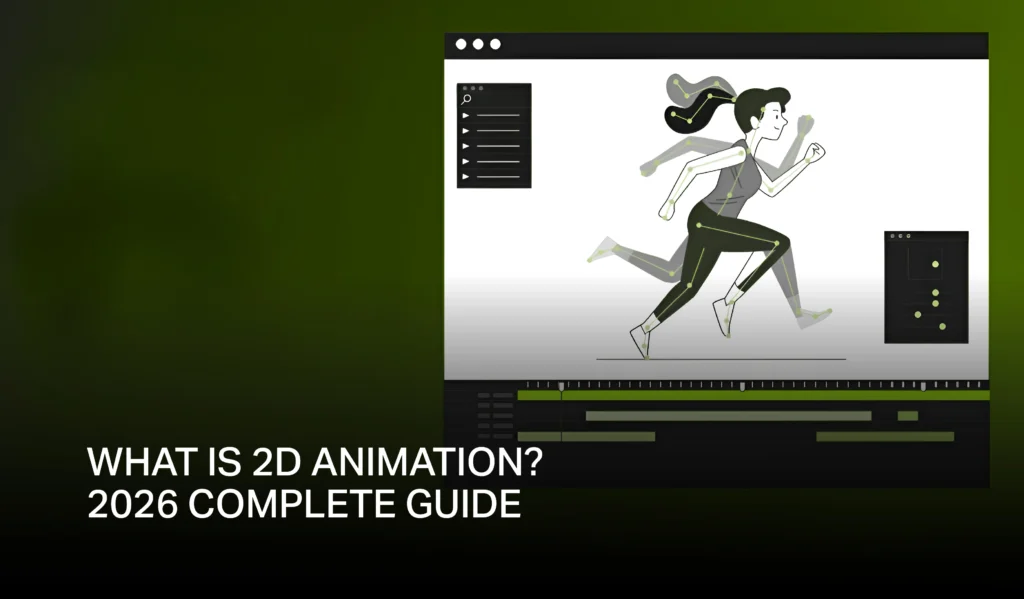
As a creative for us, the art of 2D animation lies in its capability to grab the audience’s attention, telling a clear story, and how it explain complex ideas through simple visuals. For many of you, 2D animation can only be an art of creating motion in a flat and two-dimensional space. But at Innova Designz, it gives life to our drawings or vector art by sequencing images. Further, it helps our 2D characters to move across a scene.
But wait a minute! Because there is someone else who has recently discovered the Importance of 2D Animation. Yeah, you guessed us right! We are talking about businesses that have recently opened the doors of accessibility and flexibility with 2D animation. As it continues to expand in advertising, education, entertainment, and digital media.
Its flat and expressive style offers uniqueness while supporting production workflows. So, let’s dig into it!
What Is 2D Animation: Definition and Meaning
2D animation brings life to art creations with the use of two dimensions: height and width, without depth. In easy words, you can define 2d animation as a process of showing a sequence of static images. Where each image is different from the others. That is shown in a rapid succession to create the illusion of motion.
Important Features:
- Works on the horizontal and vertical plan, which means the X and Y axes.
- Works with flat drawings, vector graphics, characters, objects, and backgrounds.
- Works by sequencing frames (drawings or digital art) so that when played quickly.
These features in 2d animation production are a popular medium for cartoons, educational videos, advertisements, and games!
Why the Importance of 2D Animation for Businesses and Creators
In today’s digital world, understanding the meaning of 2d animation has become an essential tool for businesses and creators looking to engage their audiences. But the question that arises here is how we have answered in 5 simple points:
- Unique visual appeal: 2D animation’s stylized, flat visuals can offer nostalgia and clarity.
- Across industries: Industries including entertainment, education, advertising, and marketing adopt 2D animation easily for different purposes.
- Price saving: Especially with digital 2D techniques, production becomes faster and flexible.
- Screen Size: Vector-based 2D animation grows without losing quality and is perfect for every screen size.
- Availability: 2D animation lowers the barrier to entry in the marketing industry compared to 3D modeling.
5 Types of 2D Animation With Techniques & Tools
With the types of 2D Animation, if you’re thinking about how to make a 2d animation, then we have also mentioned it techniques and tools below.
1. Traditional Animation
Traditional animation is also known as cel animation, which is a hand-drawn frame on paper or acetate (“cells”). Where each frame offers an organic, handmade feel. This type of animation is used in films and classic cartoons. The best examples: Disney’s Snow White and The Lion King.
Techniques:
- Frame-by-Frame Drawing is individually hand-drawn on paper. These images are then photographed and sequenced to create the illusion of motion.
- Inking & Painting are done once the drawing is complete, the sketches are traced over with ink and painted in vibrant colors.
- Exposure Sheets are a tool that is used to keep track of timing, movement, and the sequence of frames.
Tools:
- Animation Desk or Lightbox is used to trace and create cels.
- Cel Paints & Inks are specialized paints for making cel animation.
- Film Cameras & Rotoscoping Gear are for capturing the animation onto film.
2. Vector-Based Animation
When we talk about types of 2d animation styles, vector-based animation uses vector graphics such as paths and curves rather than raster/pixel art. In 2d animation vector graphics can be built and grow without losing quality. The best examples: The Simpsons (early seasons), and online explainer videos or web animations.
Techniques:
- Path Animation objects are defined by paths and curves (vectors) rather than pixels.
- Morphing will have you have a smooth transition between shapes or characters using vector paths.
- Tweening software is made between frames, which defines the start and end points of vectors.
Tools:
- Adobe Animate is one of the most popular vector-based animation tools in 2d animation.
- Toon Boom Harmony is used as a great vector-based professional-level tool for production.
- Synfig Studio is a free software 2D vector-based animation tool.
3. Digital 2D Animation
2D digital animation can be made with the help of different software tools, drawing tablets, rigging, and digital frame sequencing. By combining all of these in 2d digital animation, you can make production faster, and editing can be simpler. The best examples: Adventure Time and Rick and Morty.
Techniques:
- Rigging characters are designed with separate parts. Those are “rigged” together to move like a puppet.
- Layering parts of the animation is separated into layers, for example, background, foreground, and characters. This allows for easier modification and depth.
Tools:
- Adobe Animate is widely used for web animation and interactive content.
- Toon Boom Harmony is used for rigging systems and management.
- Clip Studio Paint is ideal for both frame-by-frame and digital puppet animation.
- TVPaint is known for its frame-by-frame traditional approach.
- OpenToonz is a free animation tool used for traditional and digital 2D animation.
4. Puppet Animation
When it comes to character or object animation, these are built from separate parts, such as limbs, head, etc. These parts will be moved like puppets rather than redrawn on each frame. These 2d animation techniques make smooth and simple or stylized animations. The best examples: South Park and The Amazing World of Gumball.
Techniques:
- Puppet Rigging made characters and objects in separate parts that can be used like a puppet.
- Limited Movement simplifies production; cut-out animations use limited movement with fewer frames.
- Reuse of Assets is a technique that allows characters or props to be reused multiple times, which saves time in production.
Tools:
- Adobe Animate is great for cut-out style animation using rigged character systems.
- Toon Boom Animate is known for its rigging tools for puppet-style animation.
- CrazyTalk Animator is a specialized tool for 2D puppet animation for facial rigging.
- Moho is popular for creating cut-out animation with its bone rigging system.
5. Rotoscoping
This 2d animation style uses live action footage as a base for frames to create real movement. It also allows life-like motion while offering a 2D image. The best examples: A Scanner Darkly and The Lord of the Rings.
Techniques:
- Rotoscoping is a technique where animators create realistic motion in 2D.
- Motion Capture Integration is used to capture realistic human movements.
- Animation Hybrid has mixed 2D animation with rotoscoping to create animated characters.
Tools:
- Adobe After Effects is used for rotoscoping through its tool, which removes people from the background.
- Toon Boom Harmony is used for rotoscoping and hand-drawn animation work. That is a special feature in films.
- TVPaint is often used for rotoscoping in the traditional hand-made style.
- Blender provides 2D animation with rotoscoping for stylistic effects.
Why 2D Animation Still Matters in 2026
2D animation makes its place in the online world with simplicity, clarity, and a unique style. Its flat and two-dimensional visuals offer a lush aesthetic. That shines in an increasingly saturated visual land. Its visual appeal is one of the most price-saving ways to produce high-quality animated content.
This makes it a perfect marketing material for startups, small businesses, educational content creators, and marketing campaigns. That needs to make an impact without making you invest a huge amount. Thanks to advancements in digital 2D and animation technology. Now, small teams can also create professional-level animations quickly.
The high versatility allows it to be applied across different industries such as cartoons, feature films, advertisements, explainer videos, and video games. For brands, organizations, and individuals looking to communicate with clarity, emotion, and style, 2D animation.
FAQ’s Section
What does 2D animation mean?
2D animation means creating an image in a two-dimensional plane. Artists draw or digitally produce images and display them in sequence to produce movement.
What software is used for 2D?
Several tools are used for 2D digital animation, including vector-grounded and delineation operations. Numerous workrooms use software like traditional cel- animation tools or ultramodern digital apps.
Is 2D better than 3D?
It depends on the design. 2D offers simplicity, style, and cost-effectiveness. 3D offers depth and literalism. For numerous systems, cartoons, explainers, and advertisements, 2D remains ideal.
How does 2D animation look?
It appears as flat delineations or plates moving easily across a scene. Characters and objects are represented without depth, but fluid stir and suggestive art give life and emotion to the illustrations.
What are the types of 2D animation?
- Traditional (hand-drawn/cel) animation.
- Vector- grounded vitality.
- Digital 2D vitality/ 2D digital animation.
- Cut- eschewal/ poppet animation.
- Rotoscoping and other mixed ways (stir plates, limited animation).
Why Choose Innova Designz for 2D Animation
Are you looking for a partner who can offer 2D animation appeal? Then Innova Designz is your one-step solution! That specializes in using 2D digital animation and animation technology. That will help you in creating engaging explainer videos, ads, educational content, and stylized brand stories.
Ready to change your message into a vibrant animation? Explore our 2d animation services for high-quality 2D animation!